


🧘 LIMITED STOCK DUE TO HANDCRAFTED NATURE
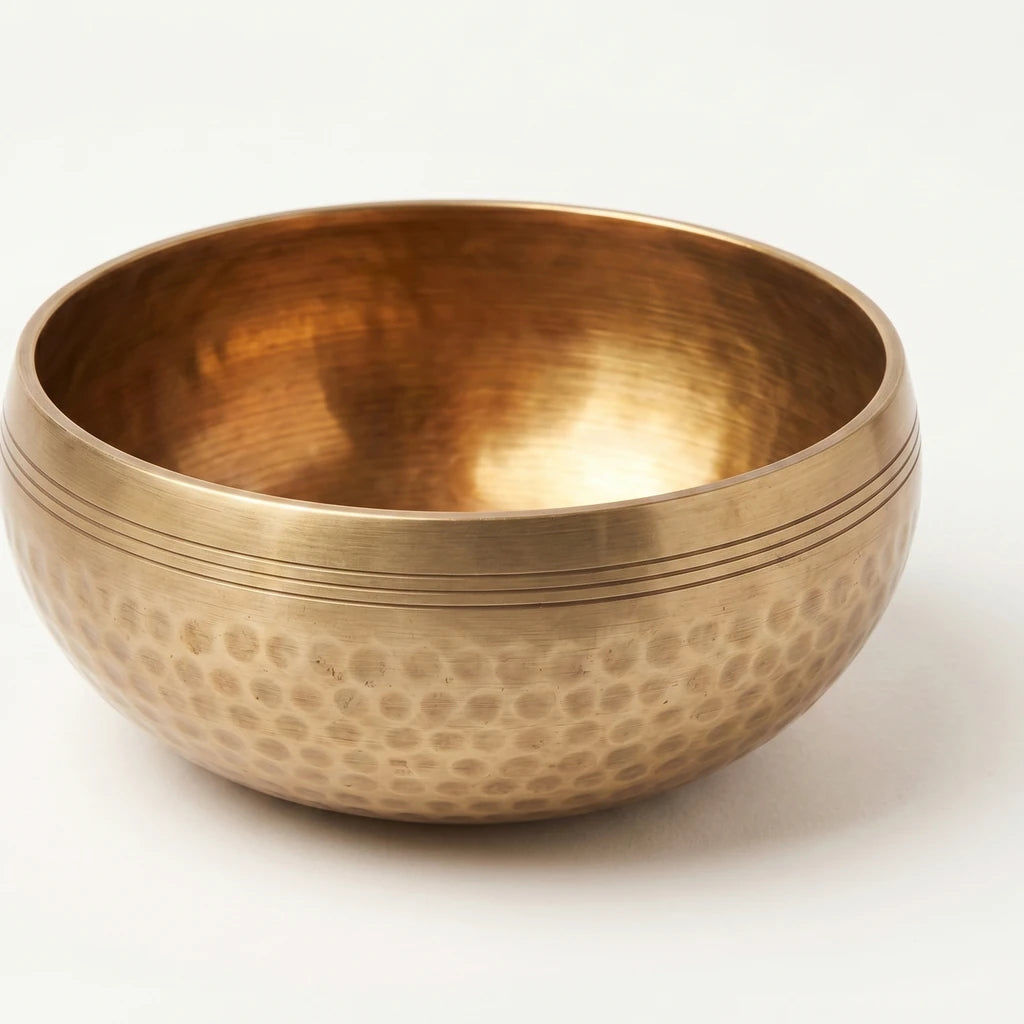
Hand-Forged Bronze Singing Bowl for Reset
Hand-Forged Bronze Singing Bowl for Reset
🧘 Asks Nothing of You: Every other fix asks your depleted nervous system to do something — more focus, more willpower, more discipline. This one asks it to receive. Sit, strike it once, and the reset happens passively — whether you can focus, sit still, or have ever once meditated.
🧠 Measured, Not Mystical: Hand-tuned to 4–8 Hz beating frequencies — the Theta band the brain enters in deep rest. In a 2023 EEG study, listeners' brainwaves synced to the bowl's beat within that band, whether they tried to or not.
🤲 You Hold It and Feel It: A recording stops at your ears. A real bowl resting in your palm sends a low-frequency vibration through air and bone — enough to raise heart-rate variability in a 2023 randomized trial. A speaker plays at you; the bowl plays through you.
🔨 Hand-Hammered Bell-Metal Bronze: Forged in Patan, Nepal by Newari smiths of the Tamrakar lineage — ~80% copper, 20% tin, the same alloy as cathedral bells. Tested for sustain and overtone density before it ships.
Choose Your Quiet Reset
Couldn't load pickup availability
One of each size, added together — the full singing bowl collection.
Hand-Forged Bronze Singing Bowl for Reset
- American express payment method
- Apple pay payment method
- Bancontact payment method
- Google pay payment method
- Master payment method
- Mbway payment method
- Paypal payment method
- Shopify pay payment method
- Unionpay payment method
- Visa payment method
Get it between - and -.
-

“Three weeks in, I actually look forward to the evening reset. That hasn't happened with any wellness thing I've tried.”
-

“Twelve minutes between client calls. I come back to the next meeting like a different person.”
-

“Bought it for the year my mom started forgetting names. The version of me who comes downstairs in the morning is finally back.”


See & hear the size difference
Nine sizes hand-hammered side by side in the same Patan workshop, sorted small to large. All voiced to the same Theta-band sustain. The only difference you'll hear is pitch and decay length, not quality.
Smallest (8 cm). Palm-sized. Travels in a carry-on. Bright tone, quick decay.
Small (9.5 cm). Nightstand companion. The size most people start with.
Midsize (12 cm). Desk or bedside reset. The most-ordered overall.
Large (15 cm). Living-room piece. Deeper fundamental, longer sustain.
Largest (20 cm). Family or shared-space sound. Lowest pitch, longest tail.
The video also includes four sizes we don't sell: 8.5, 11, 13, and 17.5 cm. Listen and you'll hear why. Each sits too close to its neighbour in our line, same fundamental band, near-identical sustain. We kept the five above because each one is spaced far enough from the next to be a meaningfully different instrument, not a cosmetic variant.
Hit play and listen to all nine in sequence.
From People Who Tried Everything Else First
-

“I'd decided this was just my age. It wasn't.”
“I spent so many years being the one everyone leans on that I stopped noticing I was running on empty. I wasn't sleeping right, I was wound up at night and foggy by the afternoon, and somewhere along the way I'd quietly decided this was just my age. I sit with the bowl for about ten minutes most evenings, and it asks nothing of me. The nights are calmer, the fog lifts, and the evenings finally feel like mine again. I feel like myself.”
-

“The first thing in two years that didn't feel like another chore.”
“Project management is the job of holding twenty things in your head at once, and mine kept running the Friday status meeting at 11 p.m. I'd tried Calm, Headspace, three breathwork apps — nothing slowed it down. The bowl is the first thing that actually gets between me and the meeting in my head. I don't have to do anything — I just hit it.”
-

“My Whoop says my HRV is up 22% over six weeks. Can't argue with the data.”
“I dispense medication for a living. So I knew I didn't want a sleep prescription, but nothing else was working. The bowl is something I'd normally be skeptical of professionally — except my Whoop says my HRV is up 22% over six weeks and my resting heart rate is down five points. Can't argue with the data.”


Anatomy of an Acoustic Regulator
-

Bell-Metal Bronze
Roughly 77–80% copper, 20–23% tin — the same alloy used for cathedral bells. It rings; it doesn't thud.
-

Hand-Hammering
Each strike work-hardens the metal; reheating realigns the grain. The wall thickness varies by fractions of a millimetre — that asymmetry is what generates the binaural beating effect.
-

Theta-Band Tuning
The bowl is hand-tuned to produce beating frequencies in the 4–8 Hz Theta band — the deep-rest, REM-recovery state the EEG identifies. Old craft, modern calibration.
-

60–120 Second Sustain
A long-tail singing tone from a single strike. The brain needs the long tail to entrain. A cheap cast bowl decays in 20–30 seconds and the mechanism never fires.


You're Not Anxious. Your Nervous System Is Stuck.
You wake at 3 a.m. with a jolt — body leaden, mind running. You sleep eight hours and wake feeling like you slept zero. You sit in the parked car for ten minutes before you can open the door. Your bloodwork came back "normal." You did not feel reassured.
You've tried the apps, the supplements, the sleep-hygiene rules. And every time, you end up right back where you started — exhausted, scattered, and quietly terrified that this is just who you are now.
It's not.
Clinicians call this autonomic dysregulation: the sympathetic nervous system gets stuck on, and the parasympathetic — the "stand-down" system — can't engage. You're not lazy. You're not undisciplined. You're a person whose body has forgotten the involuntary signal for safe.
The bowl is what gives that signal back.

Four Centuries of Hand-Hammered Acoustic Craft
Our bowls are forged in the Patan district of Kathmandu Valley by Newari craftsmen of the Tamrakar and Kansakar lineages. The same families have done this work continuously since the 16th century, supplying monasteries and household kitchens across the Himalayan foothills with bells, alms bowls, butter-lamps, and offering vessels.
Each bowl in our line is hand-hammered by a seventh- or eighth-generation smith using the same hammer-and-anvil annealing method his grandfathers used. The metallurgy is real, the lineage is real, and we work with these craftsmen to tune each bowl's acoustic profile to the 4–8 Hz Theta band documented in modern EEG research.
This isn't a product "launch." It's an old craft, calibrated to modern measurement. Each bowl is tested for sustain and overtone density before it leaves the workshop.
Old craft. Modern calibration.

Why a Passive Sound Succeeds Where Apps Fail
Meditation apps ask you to use your mind to fix your mind. That's like asking a broken engine to repair itself while driving.
The Kyimolung Handcrafted Singing Bowl works through a fundamentally different mechanism: passive acoustic regulation. Three documented effects run in parallel the moment it rings.
1. Frequency Following Response. When the auditory cortex processes a steady rhythmic pulse, neuronal firing patterns synchronise to it. Published EEG work has measured spectral magnitude increases of up to 251% in the Theta band during sound-bath exposure.
2. Vagal stimulation. The bowl's fundamental tones (50–200 Hz) propagate through air and bone. They register as low-frequency mechanical input on the vagus nerve — the body's biological brake pedal.
3. Cymatic resonance. Pour a thin layer of water into the bowl and strike it. The surface organises into visible standing waves. Your body is roughly 60% water. The same waves are running through your tissue while it plays.
The mechanism is mathematical and involuntary. It works whether you believe in it. Whether you can sit still. Whether you have ever once successfully meditated.

More From People Who Tried Everything Else
“HR for nine restaurants, two teenagers at home, a husband who works nights. I'd been running on adrenaline for as long as I could remember. The wake-up call was forgetting my own son's birthday-party plans mid-conversation with him. Three months in, my Sunday-night dread is finally gone. My daughter actually asks if we can 'do the bowl' before homework now. That's the part I didn't expect.” - Megan H.
“Logistics is a business of constant fires. I'd been waking up at 4 a.m. thinking about Monday for fifteen years. My wife bought me this for my birthday. I told her it was nice and put it in a drawer. Six weeks later, one bad night, I pulled it out, hit it, sat for fifteen minutes. Slept the rest of the night. The fires are still there. The 4 a.m. wake-ups aren't.” - Marcus W.
“Peri-menopause turned my sleep into a war zone. 2 a.m. wake-ups, hot flashes, brain that wouldn't quit. My doctor offered HRT and I wasn't ready. The 2 a.m. wake-ups didn't stop entirely, but they're shorter and I fall back to sleep — which is everything. I feel like myself in the mornings again.” - Maggie O.
Kyimolung's Results


Real buyers · real photos
1,200+ five-star reviews. 4.9 stars. And they sent pictures.
4.9
★★★★★
out of 5 · 1,200+ verified reviews

★★★★★
“The 3 a.m. wake-ups were the worst part of my year. I keep this on the nightstand now — when I jolt awake I ring it, sit for ten minutes, and most nights I actually drift back. Didn’t expect a metal bowl to do what melatonin couldn’t.”
Diane K.
Spokane, WA · ✓ Verified buyer


★★★★★
“Ten minutes before bed. Head quiet. I sleep. That’s the review.”
Hank P.
Toledo, OH · ✓ Verified buyer

★★★★★
“It’s become the last thing I do before the lamp goes off. A few minutes of the tone and the day finally lets go of me. My husband’s started doing it too.”
Lillian P.
Burlington, VT · ✓ Verified buyer


★★★★★
“My sleep fell apart in my mid-forties — the 2 a.m. wide-awake, the heat, the brain that wouldn’t quit. I’d tried magnesium, herbal tea, three sleep apps, and a small fortune in pillows. ‘It’s just your age’ was all I got from anyone. This is the first thing that meets me at 2 a.m. instead of arguing with me. The wake-ups still happen, but they’re shorter, and I fall back — which, honestly, is the whole game. I feel like a person in the mornings again.”
Yolanda C.
El Paso, TX · ✓ Verified buyer

★★★★★
“First thing I noticed was the weight — this is a serious piece of metal, you can see every hammer mark. Strike it once and it sings for a full minute. A cheap one I had years ago barely managed ten seconds.”
Theo R.
Sacramento, CA · ✓ Verified buyer


★★★★★
“Skeptical engineer, came for the linked studies, stayed because my watch agrees. HRV up, resting heart rate down on the nights I use it. I don’t do vibes; I do numbers. The numbers moved.”
Spencer K.
Ann Arbor, MI · ✓ Verified buyer

★★★★★
“Did the water trick the page mentions — you can literally see the sound move. But the real thing is you feel it in your chest, not just your ears. A playlist never did that for me.”
Wesley G.
Boise, ID · ✓ Verified buyer
★★★★★
“The only thing on my nightstand that isn’t a screen. That alone has helped.”
Roberta L.
Salem, OR · ✓ Verified buyer

★★★★★
“I do ten minutes after the kids are down, before I’d normally start doomscrolling. The wind-down is real — I get to bed earlier and I’m not wired.”
Naomi F.
Providence, RI · ✓ Verified buyer
★★★★★
“Let me save you my mistakes: weighted blanket, mouth tape, two sleep-tracking rings, a sunrise alarm, and enough magnesium to choke a horse. None of it touched the tired-but-wired thing where my body’s done at nine and my brain’s wide awake at midnight. This is the first thing that gets between me and the noise. I don’t have to do anything — I just ring it and sit. A little annoyed it took me this long to try something that simple.”
Annette D.
Duluth, MN · ✓ Verified buyer

★★★★★
“Phone goes face-down, bowl gets struck, brain gets the message that the day is over. Stupid simple. Works better than the meditation app I paid for two years and opened twice.”
Curtis B.
Omaha, NE · ✓ Verified buyer
★★★★★
“I work nights and my sleep is permanently scrambled. Six weeks in, my ring shows I’m actually getting more deep sleep on the days I do this before bed. Small change, but I’ll take any win.”
Kofi A.
Columbus, OH · ✓ Verified buyer

★★★★★
“Used to wake up feeling like I’d been hit by a truck even after eight hours. Mornings are softer now. I don’t want to oversell it, but the difference is real enough that I noticed within a couple of weeks.”
Joanne M.
Tacoma, WA · ✓ Verified buyer
★★★★★
“Bloodwork normal, doctor shrugged, I was on my own. This actually helped. Go figure.”
Bridget M.
Reno, NV · ✓ Verified buyer

★★★★★
“Beautiful object, does one thing well. Lives on my shelf where everyone asks about it — then I tell them about the 3 a.m. thing and they get it.”
Priya D.
Austin, TX · ✓ Verified buyer
★★★★★
“Two months in and the Sunday-night dread that used to keep me up is just… quieter. I don’t fully understand it. I’ve stopped needing to.”
Sam W.
Lincoln, NE · ✓ Verified buyer

★★★★★
“My counselor kept saying find something ‘bottom-up’ that didn’t ask my tired brain to fix my tired brain. Apps never stuck. This sits on the kitchen table, and when the house gets loud I ring it and we all settle. My daughter asks to ‘do the bowl’ before bed now.”
Marisol T.
Fresno, CA · ✓ Verified buyer
★★★★★
“You don’t just hear it — you feel it move through the room and through you. A streamed track never did that. It’s the difference between a photo of a fire and an actual fire.”
Charlene B.
Mobile, AL · ✓ Verified buyer

★★★★★
“Heavier than I pictured and beautifully made — the hammer marks are all slightly different, you can tell a person made it. Holding it while it rings is half the point. Quality you feel in your hands.”
Glenn A.
Akron, OH · ✓ Verified buyer
★★★★★
“Three weeks of better nights. First time in years I’ve been able to say that.”
Trevor N.
Chattanooga, TN · ✓ Verified buyer

★★★★★
“The sleep mask and the white-noise machine are still here, but this is the one I actually reach for. Strike, breathe, lights out. My shoulders drop before I even notice.”
Frances W.
Athens, GA · ✓ Verified buyer
★★★★★
“No app, no charging, no login. It just sits there and works. Thank god.”
Otto F.
Green Bay, WI · ✓ Verified buyer

★★★★★
“This is my between-the-day-and-the-night thing now. Ten minutes in the reading chair, then I can actually put the day down. The racing-mind part of bedtime is so much shorter.”
Eli S.
Burlington, NC · ✓ Verified buyer
★★★★★
“I bought it half-expecting woo-woo nonsense and a drawer destiny. Instead it’s the calmest ten minutes of my night, every night. The tone goes on for ages from a single strike — you feel it settle you before your head even catches up.”
Dana R.
Boise, ID · ✓ Verified buyer
Verified-buyer reviews from people who use the bowl as part of their wind-down. Individual experiences vary — these are personal accounts, not medical claims or a promise about your sleep.
Frequently Asked Questions
Why this isn't another meditation gadget
Why this isn't another meditation gadget
Most "mindfulness tools" are just repackaged apps, timers, or another subscription. They rely on your willpower — the very thing that's already exhausted — to work.
The bowl works in the opposite direction. It's a passive acoustic regulator: an external rhythmic sound that entrains your brain involuntarily, whether you're focused or wandering. The Frequency Following Response engages on its own. The vagus nerve fires on its own. The cymatic waves run through your tissue on their own.
No app. No voice telling you to breathe. No quiet room you don't have. No 30 uninterrupted minutes. Sit, strike the bowl, breathe normally — twelve minutes is enough.
This is not mysticism. It is acoustic physics and polyvagal biology — measurable in EEG and HRV data, documented across thirty-plus years of research, used continuously in Patan workshops for four centuries.
How do I use the bowl?
How do I use the bowl?
No mantras. No counting. No "doing it right." Hold the bowl in your palm or rest it on the cushion that ships with it. Strike the rim once with the leather striker, then run the striker slowly around the outer rim with light pressure — like stirring honey. Sit. Breathe normally. Let it work. Twelve minutes is enough. If your mind wanders, fine. The mechanism does not require you to focus.
Where are your bowls made?
Where are your bowls made?
Our bowls are forged in the Patan district of Kathmandu Valley, Nepal, by Newari craftsmen of the Tamrakar (copper-workers) and Kansakar (metal-workers) lineages. The same families have done this work continuously since the 16th century — supplying monasteries and household kitchens across the Himalayan foothills with bells, alms bowls, butter-lamps, and offering vessels. Each bowl is hand-hammered by a seventh- or eighth-generation smith using the same hammer-and-anvil annealing method his grandfathers used, then tuned and tested for overtone density before it ships. Nothing is poured into a mould. Nothing is mass-produced. The asymmetry from hand-hammering is what generates the binaural beating effect — and the entire mechanism falls apart without it.
What size bowl should I buy?
What size bowl should I buy?
We offer five sizes, $59.99 to $239.99 USD. Smaller bowls run higher and brighter; larger bowls sit lower in the body and run longer. The underlying physics is the same — every bowl in the line is tuned to produce beating frequencies in the 4–8 Hz Theta band. Pick the one that fits your room and your budget. If you're buying for more than one room, the bundle discount (10% off any two, 20% off any three) applies automatically at checkout, and you can mix and match across sizes.
How is this different from meditation?
How is this different from meditation?
Meditation is top-down: it asks your conscious mind to direct your attention. The bowl is bottom-up: an external acoustic rhythm entrains your brain involuntarily, whether you're focused or wandering. If meditation has ever felt impossible — too much sitting still, too much arguing with your own thoughts — that's the difference. The bowl bypasses the part of you that has been trying to focus for years.
Who is Kyimolung?
Who is Kyimolung?
Kyimolung was founded to bring authentic Himalayan craft tools to practitioners around the world. Our name comes from the Tibetan "Beyul" — a hidden sacred valley in the Himalayas. We work directly with Newari lineage holders in Patan, Nepal, who maintain centuries-old metalwork traditions, ensuring every bowl we offer is hand-hammered with the same care, materials, and acoustic intent as the bowls used in monastic and household practice across the Himalayan foothills.
How long will shipping take?
How long will shipping take?
Standard delivery is estimated at 5–10 business days. We ship items 6 days a week and provide full order tracking on every package.
90-Day "Any Reason" Return
90-Day "Any Reason" Return
Resetting an autonomic loop that has been running for years takes time. That's why we don't ask you to "love it in 7 days or send it back."
Use your bowl for a full 90 days. Twelve minutes most weekdays is enough — give your nervous system the time it needs to rebuild the parasympathetic response. If, after three months of honest use, you don't feel a measurable change in the way you wind down at night — we'll refund every cent, including shipping. No forms. No questionnaire. No hassle.
We keep the carbon, you keep the bowl. Easier for everyone.
What is your return policy?
What is your return policy?
Every bowl comes with a full 90-day money-back guarantee. If you are not completely satisfied, simply return the bowl and we will provide a full refund — including shipping — no questions asked. We believe in the mechanism, and we want you to experience it with zero risk.